How do you write SMART IEP goals for speech therapy? Start from real evaluation data, name one skill you can see or hear, and add the setting, the support, a countable criterion and a date. IEP goal software for SLPs can draft a goal from that data, but the SLP and the IEP team decide what goes in the IEP.
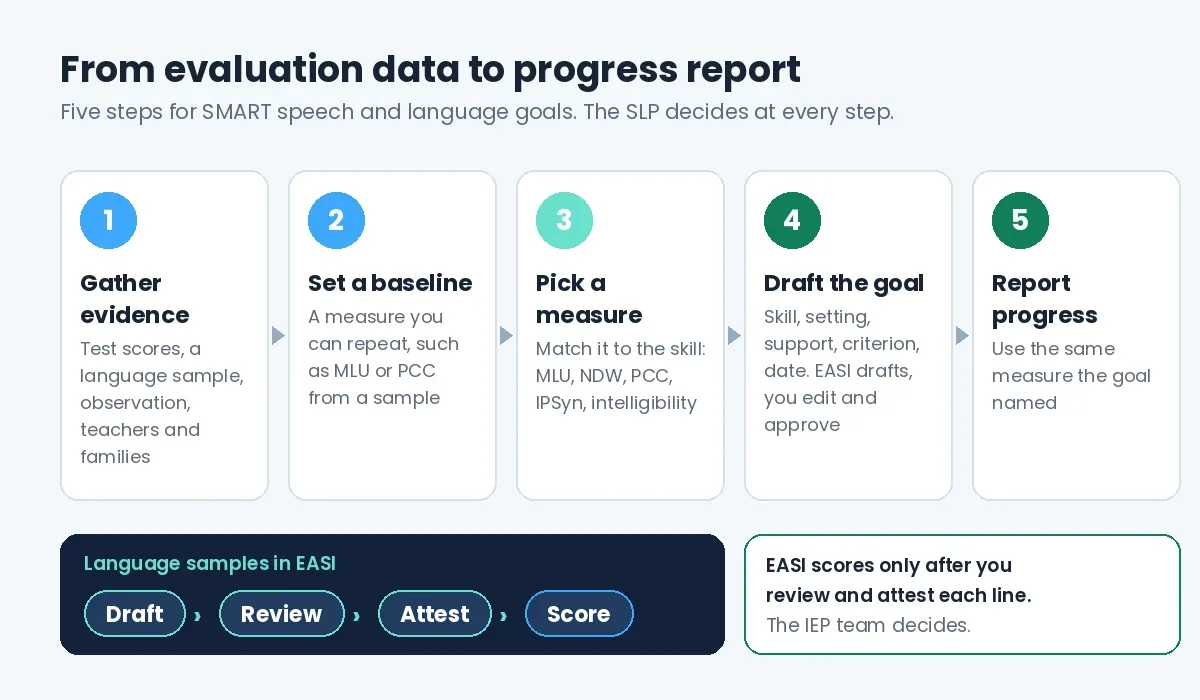
- Gather evaluation evidence.
- Set a baseline from that evidence.
- Pick a measure that fits the skill.
- Draft the goal, then edit every word.
- Track progress with the same measure.
Why SMART speech goals start with the evaluation
Under IDEA, every IEP must include "a statement of measurable annual goals, including academic and functional goals" (34 CFR 300.320). The same regulation asks the IEP to describe how progress toward each goal will be measured and when progress reports will be provided.
That makes the goal the middle of a chain. The skills named as needs in the evaluation should be the same skills in the present levels, the goals and the progress reports. When one link is weak, the goal is hard to measure and hard to report on.
Step by step: where each part lives
| Step | What the SLP does | Read more |
|---|---|---|
| 1. Gather evidence | Combine test scores, a language sample, observation and what teachers and families say. No single cutoff score decides eligibility. | Is a cutoff score enough for eligibility? |
| 2. Document what the test can't show | If a child couldn't complete a standardized test, write a validity statement and lean on functional evidence. | Documenting invalid test results |
| 3. Set a baseline | Use a measure you can repeat later, such as MLU from a language sample. | How to calculate MLU |
| 4. Draft and edit the goal | Fill in the skill, setting, support, criterion and date. | SMART IEP goal examples for SLPs |
| 5. Report progress | Report with the same measure the goal named. | Drafting a progress report in EASI |
Choose a measure you can repeat
A goal is only as good as the way you check it. Match the measure to the skill.
- Sentence length and grammar: MLU, or how often the child uses a target form, from a language sample.
- Vocabulary: number of different words (NDW), compared across samples of the same length.
- Speech sounds in conversation: percent consonants correct (PCC) from a reviewed transcript.
- Intelligibility: for example, how much of a child's connected speech a listener can understand, measured the same way in each sample.
- Sentence complexity: IPSyn (Index of Productive Syntax), from a sample long enough to support it.
- Narrative: story parts included in a retell.
- Social communication and AAC: how many times, or for how many different reasons, the child communicates in a set activity.
If you use a language sample for the baseline, use the same kind of sample and the same counting rules when you measure progress.
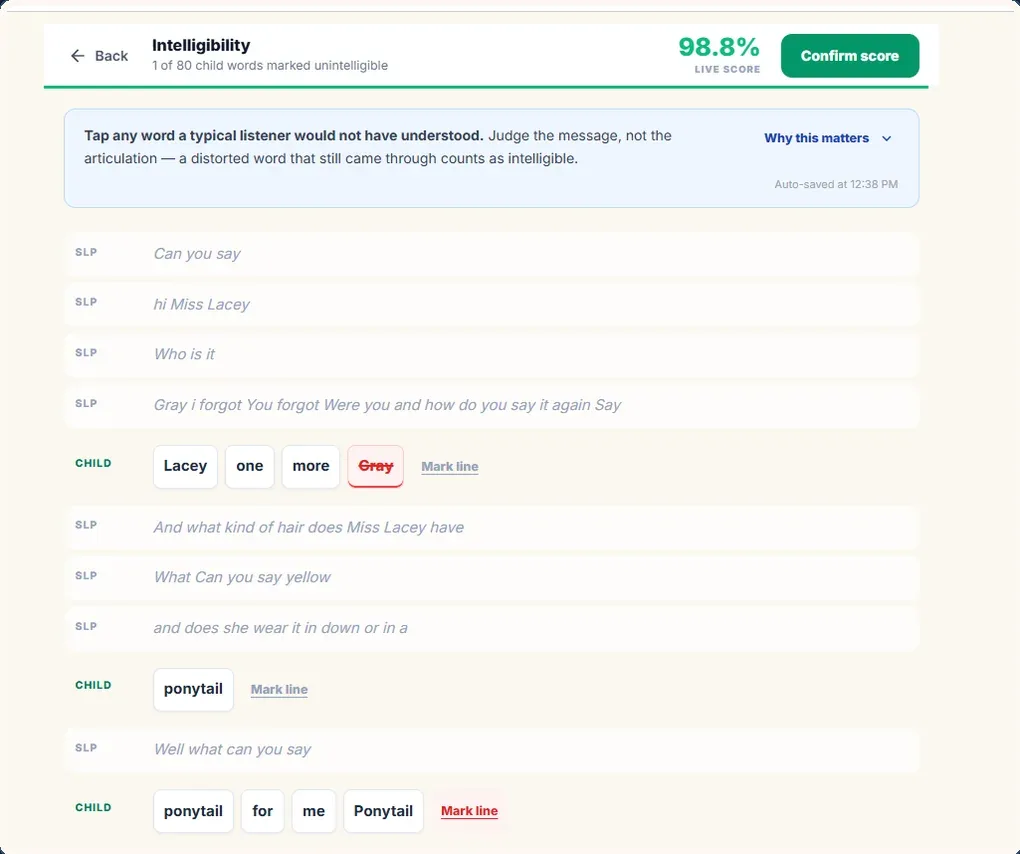 In EASI, the SLP marks unintelligible words line by line and confirms the intelligibility score. Demo sample shown.
Example SMART speech and language goals
These are examples for the clinician to adapt, not goals to copy. Fill in the brackets with the child's real baseline and your team's dates. For more examples across speech sounds, directions, social communication, AAC and literacy, see the SMART IEP goal examples post.
Example 1: Vocabulary (NDW) By [date], during a story retell with picture support, [Name] will use at least [target] different words in a 50 utterance language sample, up from a baseline of [baseline], measured in 2 consecutive samples of the same length.
Example 2: Grammatical morphemes By [date], during structured play and conversation, [Name] will use regular past tense ed in 8 of 10 required contexts across 3 sessions, measured by the morpheme breakdown of a reviewed language sample and clinician data.
Example 3: Narrative retell By [date], when retelling a familiar story with a visual story map, [Name] will include the character, setting, problem and ending in 4 of 5 retells, with no more than one verbal prompt, measured by clinician data.
Example 4: Speech sounds in conversation (PCC) By [date], in a conversational sample of at least 50 utterances, [Name] will increase percent consonants correct from [baseline] to [target], measured from a clinician reviewed transcript.
What to look for in IEP goal software for SLPs
Software can help with the parts of goal work that take the most effort, as long as the clinician stays in charge. Look for software that:
- Drafts, never decides. A goal draft is a starting point. The SLP edits it and the IEP team decides eligibility, services and the final goals.
- Uses this child's evidence. Drafts should come from the evaluation and the language sample, not from a generic goal bank.
- Shows its data. You should be able to check the transcript and measures behind any draft.
- Carries goals into progress reports, so you report with the measure the goal named.
- Protects student data. Ask about HIPAA, FERPA and a BAA before you enter student information.
Where EASI fits
EASI is a caseload and evaluation workspace for SLPs. For a language sample, EASI follows four steps: Draft, Review, Attest, Score. EASI drafts the transcript, you review and correct it, you attest each line, and only then does EASI calculate MLU, NDW, PCC, IPSyn, intelligibility and a morpheme breakdown, when the sample supports them.
From the evaluation, EASI drafts SMART IEP goals for you to review. You edit every word, check each goal against the present levels, and decide what goes to the IEP team. EASI never decides eligibility, and the IEP stays with you and the IEP team. Evaluation report drafting (in beta) is also available. MySLP, the secure AI assistant built into EASI, can help draft session plans and data sheets around the goals you set. You decide what to use.
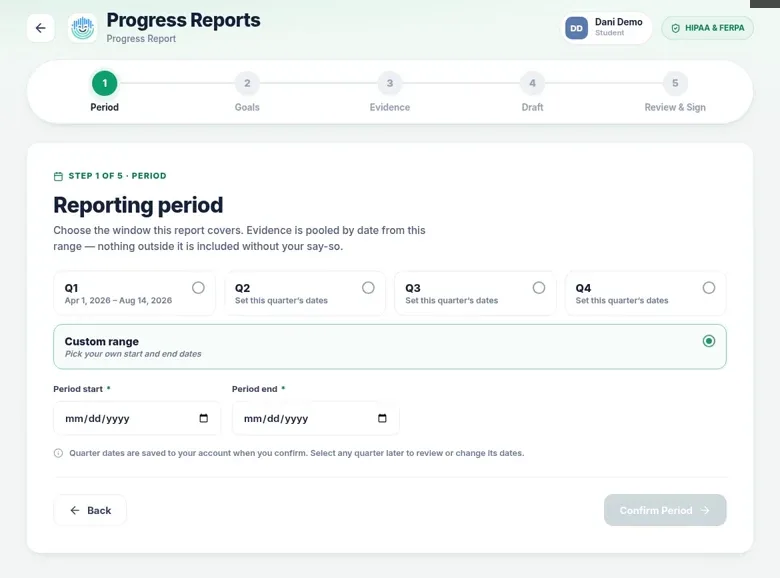 A progress report in EASI starts with the reporting period, then the goals, the evidence, the draft, and your review and signature. Demo student shown.
EASI is HIPAA and FERPA compliant, with a BAA and insurance.
FAQ
Can software draft IEP goals for SLPs? Yes, software can draft a goal, but it can't decide one. EASI drafts SMART IEP goals from the evaluation for the SLP to review, edit and approve. The IEP team makes the final decisions.
What is the difference between a measurable goal and a SMART goal? IDEA asks for measurable annual goals. SMART (specific, measurable, achievable, relevant, time bound) is one common way school teams check that a goal is measurable and fits the child.
Can a language sample be the baseline for an IEP goal? Yes. Measures such as MLU, NDW, PCC, IPSyn and intelligibility from a language sample can set a baseline you can repeat later. Use the same kind of sample each time. See how long a language sample should be.
How often should progress toward speech goals be reported? The IEP itself says when periodic progress reports will be provided, such as quarterly or with report cards (34 CFR 300.320). Report with the same measure the goal named.
Does EASI decide eligibility or write the IEP? No. EASI drafts; the SLP reviews, edits and approves. Eligibility and the IEP stay with the clinician and the IEP team.
Is EASI safe to use with student data? EASI is HIPAA and FERPA compliant, with a BAA and insurance.
Get EASI
Get EASI at NorthernSpeech.com/EASI. Groups of 10 or more can email info@northernspeech.com.
References
Individuals with Disabilities Education Act regulations, 34 CFR 300.320, Definition of individualized education program. https://www.ecfr.gov/current/title-34/section-300.320