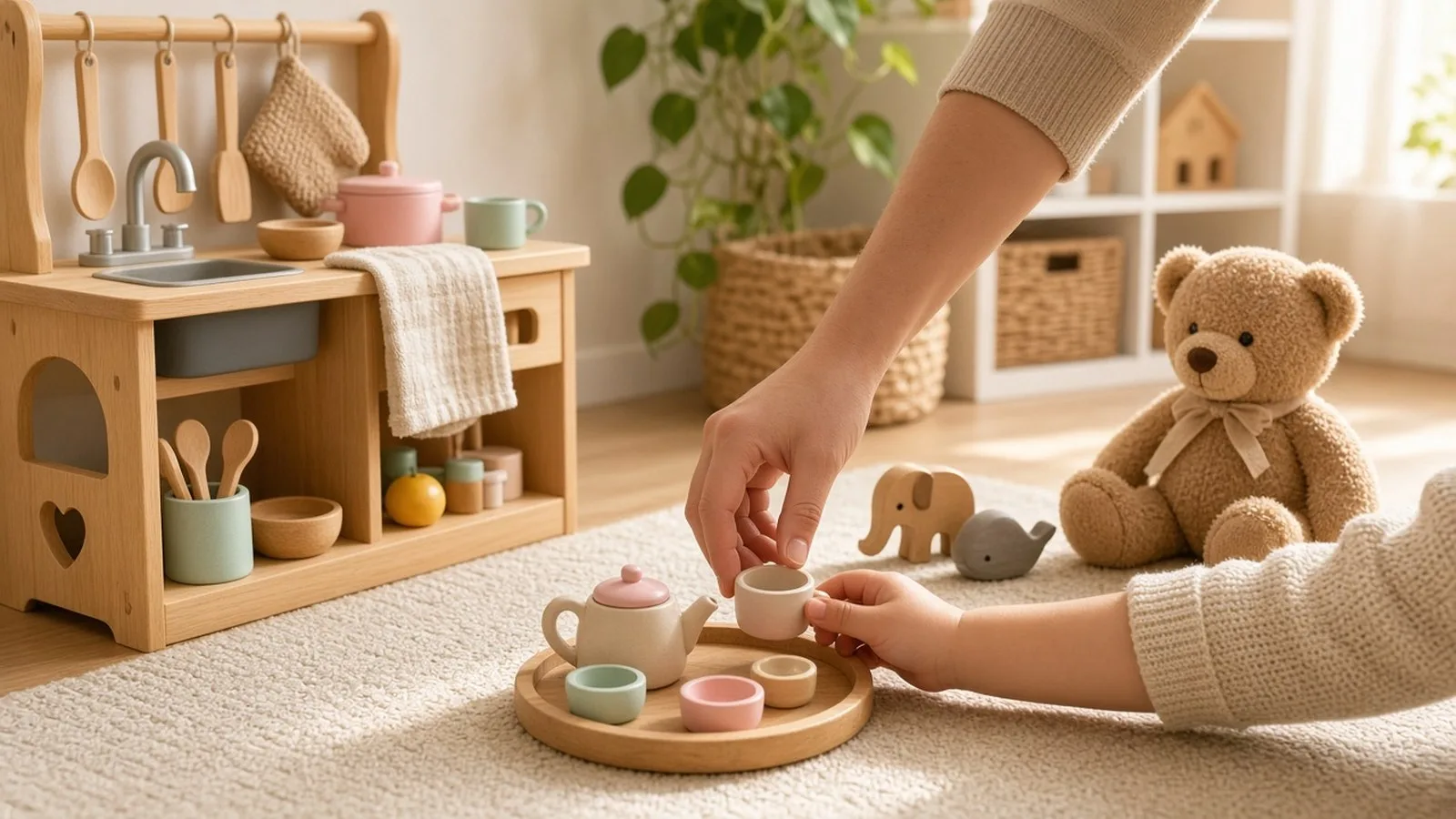
When a young child can't complete a standardized test the way the manual requires, don't report a standard score as if the test were valid. Write a clear validity statement that says what you attempted and why the results don't reflect the child's skills, then build your evaluation from other evidence, such as a play based language sample, parent report and observation.
Recently, a school SLP described a familiar day. The consent form listed a standardized test, but an almost 4 year old couldn't attend to it, and the SLP wondered how to write it up. Colleagues offered generous, practical advice: document everything you tried, keep the tone respectful of the child, and make sure the report accounts for each test named on the consent. Here is how to put that advice into a report you can stand behind.
Can you report scores from a test you couldn't finish?
Usually not as standard scores. IDEA requires that assessments be used for purposes for which they are valid and reliable and be administered in accordance with the producer's instructions (34 CFR 300.304(c)(1)(iii), (v)). If the child couldn't complete the test as standardized, the norms don't fit what happened.
Check the manual first. Some tests allow specific accommodations, extra teaching items or testing across more than one session. If you stayed within those rules, the score may still apply. If you went beyond them, describe the child's performance in words instead. ASHA notes that when a test is translated or used with a population it was not designed for, standard scores are not reported and a narrative description is used instead (ASHA, Spoken Language Disorders). The same reasoning fits a test the child could not complete as standardized.
How do you write a validity statement for an invalid test?
ASHA's guidance on documentation in schools includes a validity statement in the standard report format: a statement about whether the administration and interpretation procedures were valid for the intended purposes and accurately reflect the student's current functioning, including any procedural modifications (ASHA, Documentation in Schools). ASHA offers an example: "Assessment was attempted; however, based on the student's cognitive functioning and/or behaviors, the assessment tool was not appropriate or did not accurately measure the student's performance."
A strong statement covers four things:
- What you attempted. Name the test and the parts you tried.
- What you tried to support the child. For example: testing at a different time of day, a quieter room, short movement breaks, a fidget, a familiar adult nearby, extra practice items if the manual allows them, or splitting the session.
- What you observed. Describe behavior neutrally. "[Child] attended to 3 picture plates before moving to the toy shelf" says more, and blames less, than "[Child] was noncompliant."
- What it means. State that the results are not considered a valid estimate of the child's skills and are not reported as standard scores.
Many districts expect the report to account for every assessment named on the consent form. Check your district's procedures, and name the test even when you could not complete it.
What evidence can you gather instead?
IDEA asks for a variety of assessment tools and strategies, including functional information and information from the parent, and says no single measure can be the sole criterion (34 CFR 300.304(b)). For young children, ASHA says multiple sources of information are necessary, such as parent report, observation and language sampling. ASHA also notes that when a child is not represented in a test's normative group, the test cannot be used to determine the presence or absence of a disorder, even when it is given as instructed (ASHA, Late Language Emergence).
How do you get a play based language sample from a preschooler?
Play is often where a young child shows the most. In one small study of 5 year olds, free play produced more utterances than story generation, though a smaller share of complex sentences (Southwood & Russell, 2004). Research with 3 year olds used parent and child play to gather conversational samples (Guo & Eisenberg, 2015).
Tips for a sample you can use:
- Invite a parent to play. A familiar partner can draw out more natural talk.
- Use the child's interests. Bring a few favorite toys, then follow the child's lead.
- Talk less, wait more. Comment instead of quizzing, and give the child room to talk.
- Record it. A recording lets you check your transcript later.
- Aim for enough talk. Short samples can be reliable for some measures (Heilmann, Nockerts, & Miller, 2010), but 3 year old research suggests 7 to 10 minutes is desirable (Guo & Eisenberg, 2015). See our guide, How Long Should a Language Sample Be?
Dynamic assessment
A test, teach, retest approach shows how the child learns. In a study of culturally and linguistically diverse preschool children, a dynamic assessment of word learning distinguished children with typical and low language ability better than a static pretest (Peña, Iglesias, & Lidz, 2001).
What about speech sounds?
The test in the original question was a speech sound test, so this matters. A language sample is language evidence. Speech sound skills need their own measures, chosen by you for this child. ASHA describes speech sound assessment as using standardized instruments as appropriate along with other sampling procedures in single words and connected speech, plus stimulability testing (ASHA, Speech Sound Disorders: Articulation and Phonology). In this post, EASI's role is the language sample.
Who decides eligibility?
The team does. A group of qualified professionals and the parent determines whether the child is a child with a disability (34 CFR 300.306(a)(1)). Your report makes the evidence clear. EASI never decides eligibility or diagnoses a child.
Where EASI fits
EASI is language sample analysis software for English language samples. You can record live using the built in pictures, upload a recording or bring in an existing transcript. The workflow is Draft, Review, Attest, Score: EASI drafts the transcript, you confirm who spoke, fix any words and attest each line, and then, when the sample supports it, EASI calculates language measures such as mean length of utterance and number of different words for you to interpret. Our guide on how to edit an EASI transcript shows each step. A short sample is reported as a short sample. Compare tools in EASI vs SALT.
MySLP, the secure AI assistant built into EASI, answers SLPs' clinical, scientific and eligibility questions, so you can ask it how to word a validity statement and review what it suggests. When you're ready, report drafting (in beta) can prepare a draft from your reviewed findings for you to edit and sign.
EASI is HIPAA and FERPA compliant, with a BAA and insurance.
Where can you get EASI?
Get EASI, with MySLP included, at NorthernSpeech.com/EASI. Northern Speech Services is the exclusive distributor.
FAQ
What do you write when a standardized test isn't valid? A validity statement: what you attempted, the supports you tried, what you observed and that results are not reported as standard scores.
Should I list a test I couldn't complete? Yes. Name it, describe what you attempted and observed, and explain why you are not reporting standard scores. Follow your district's procedures for tests listed on consent.
Can I give the test again later? Often you can try another session if the manual allows it. Note the dates, conditions and any changes.
Is a play based language sample enough on its own? No single measure is enough. Pair it with parent report, observation and other measures you choose.
Does EASI score speech sounds in this workflow? This post covers language. Choose speech sound measures separately for the child.
References
- American Speech Language Hearing Association. (n.d.). Documentation in schools [Practice Portal]. https://www.asha.org/practice-portal/professional-issues/documentation-in-schools/
- American Speech Language Hearing Association. (n.d.). Late language emergence [Practice Portal]. https://www.asha.org/practice-portal/clinical-topics/late-language-emergence/
- American Speech Language Hearing Association. (n.d.). Speech sound disorders: Articulation and phonology [Practice Portal]. https://www.asha.org/practice-portal/clinical-topics/articulation-and-phonology/
- American Speech Language Hearing Association. (n.d.). Spoken language disorders [Practice Portal]. https://www.asha.org/practice-portal/clinical-topics/spoken-language-disorders/
- Assistance to States for the Education of Children With Disabilities, 34 CFR 300.304, 300.306. https://www.law.cornell.edu/cfr/text/34/part-300
- Guo, L. Y., & Eisenberg, S. (2015). Sample length affects the reliability of language sample measures in 3 year olds: Evidence from parent elicited conversational samples. Language, Speech, and Hearing Services in Schools, 46(2), 141 to 153. https://doi.org/10.1044/2015_LSHSS-14-0052
- Heilmann, J., Nockerts, A., & Miller, J. F. (2010). Language sampling: Does the length of the transcript matter? Language, Speech, and Hearing Services in Schools, 41(4), 393 to 404. https://doi.org/10.1044/0161-1461(2009/09-0023)
- Peña, E., Iglesias, A., & Lidz, C. S. (2001). Reducing test bias through dynamic assessment of children's word learning ability. American Journal of Speech Language Pathology, 10(2), 138 to 154. https://doi.org/10.1044/1058-0360(2001/014)
- Southwood, F., & Russell, A. F. (2004). Comparison of conversation, freeplay, and story generation as methods of language sample elicitation. Journal of Speech, Language, and Hearing Research, 47(2), 366 to 376. https://doi.org/10.1044/1092-4388(2004/030)